Apparel brand owners, sourcing directors, and fashion buyers frequently encounter a frustrating manufacturing problem: “We provided accurate CAD tech packs, measurements, and design sketches, yet the final custom jeans sample feels completely off compared to our original vision.”
This disconnect between initial design specs and final garments stems from three invisible manufacturing variables: paper pattern ergonomics, industrial wash scaling, and fabric structure variations. When sourcing custom jeans bulk manufacturing, evaluating factories solely on FOB price or basic size charts leads to fit issues, inconsistent vintage washes, and unpredictable fabric shrinkage across production batches.
This B2B sourcing guide breaks down the engineering differences between basic garment factories and professional custom denim manufacturers, helping fashion brands elevate product quality and avoid sample revision traps.
The Three Hidden Barriers in Custom Denim Manufacturing
Achieving consistent quality in custom jeans bulk manufacturing requires much more than selecting the right denim fabric or following a standard tech pack. In practice, pattern development, industrial washing, and fabric engineering all influence the final fit, appearance, comfort, and production consistency.
Therefore, apparel brands sourcing custom denim jeans should evaluate a manufacturer’s engineering capabilities before placing a bulk order. A factory may be able to produce a basic denim sample, but scaling that sample into thousands of consistent garments requires more advanced production controls.
The following comparison highlights the key differences between a basic garment factory and a professional OEM denim manufacturer such as YLC.
| Engineering Factor | Basic Garment Factory | Professional OEM (YLC) |
|---|---|---|
| Pattern Library | Generic Asian standard grading | Target-market ergonomic database for US/EU profiles |
| Denim Wash Consistency | Hand-washed laboratory samples that are difficult to scale | Industrial automated wash recipes and laser abrasion |
| Fabric Specification | Evaluates basic composition and weight, such as 98% cotton / 2% spandex | Controls yarn count, weave tension, stretch, and recovery |
| Pre-Production Sample Approval | Digital photos or a single physical sample | Triple-Sample Kit: Fit Sample + Wash Panel + Fabric Swatch |
As a result, these three engineering areas should be considered together when evaluating a supplier for custom jeans bulk manufacturing.
1. Pattern Engineering: Target-Market Ergonomics
A denim tech pack normally provides measurements such as waist, hip, inseam, rise, and leg opening. However, these static measurements alone cannot fully describe how a pair of jeans should fit on a three-dimensional human body.
For this reason, professional denim pattern development requires careful consideration of dynamic spatial volume.
Basic factories may rely on generic 2D grading curves. While this approach can reduce development time, it may also result in common fit problems such as:
- Crotch pulling
- Waistband gapping
- Excess fabric around the seat
- Restricted knee mobility
- Uneven leg drape
- Inconsistent fit between sizes
By contrast, professional denim manufacturers can use region-specific pattern databases based on different target-market body proportions.
For example, US and EU customers may have different body proportions and fit expectations. Therefore, pattern engineers need to consider factors such as:
- Rise curvature
- Hip and seat volume
- Waist-to-hip ratio
- Inseam length
- Knee position
- Leg silhouette
- Overall garment balance
As a result, target-market-specific pattern engineering can help brands achieve a more predictable fit across different size ranges.
2. Industrial Wash Scaling: From Lab Samples to Bulk Production
Denim washing is another major challenge in custom jeans bulk manufacturing.
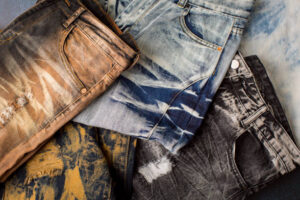
Unlike conventional garment finishing, denim washing combines chemical reactions with mechanical abrasion. Depending on the desired appearance, manufacturers may use processes such as:
- Stone washing
- Ozone bleaching
- Hand scraping
- Enzyme washing
- Laser distressing
- Other controlled finishing processes
However, a critical issue appears when a factory moves from sample development to bulk production.
The Scale Gap
A small denim sample washed in a 5 kg laboratory drum does not necessarily behave the same way as a 500 kg industrial production wash cycle.
The larger production environment changes factors such as:
- Fabric-to-water ratio
- Chemical concentration
- Mechanical abrasion
- Temperature distribution
- Washing time
- Garment loading
- Drum movement
Therefore, simply copying a laboratory washing formula may not produce the same result during bulk production.
The Professional Solution
Professional denim manufacturers use industrial washing equipment together with standardized chemical recipes and controlled production parameters.
The approved sample can then serve as a golden sample for bulk production comparison.
During manufacturing, production teams can evaluate key visual and tactile characteristics, including:
- Wash hue
- Fading contrast
- Whisker appearance
- Abrasion intensity
- Softness
- Overall shade consistency
As a result, industrial wash scaling helps reduce shade variations between production batches and minimizes costly rework or re-sampling.
3. Fabric Geometry: Why Composition Labels Are Not Enough
Fabric selection is another important factor in successful custom jeans bulk manufacturing. However, simply comparing fiber composition and fabric weight is not enough.
For example, two denim fabrics may both be labeled:
98% Cotton / 2% Spandex / 12 oz
Yet, they can have completely different appearances, handfeel, stretch behavior, and recovery performance.
Therefore, professional denim sourcing should examine the underlying fabric structure rather than relying solely on the composition label.
Yarn Twist and Spinning Method
The yarn construction has a direct influence on the visual and tactile characteristics of denim.
For example, open-end yarn can produce a more rugged, vintage workwear texture. In comparison, ring-spun yarn can create a smoother and more premium handfeel, often with a distinctive slub character.
Consequently, brands targeting different market positions should select yarn construction according to the desired aesthetic and product positioning.
Stretch Recovery
Stretch recovery is equally important for fitted or stretch denim.
Low-quality elastane can lose recovery performance after repeated washing or intensive finishing processes. As a result, areas such as the knees may become baggy over time.
Premium ring-spun stretch denim, however, can provide better recovery retention after washing when properly engineered.
Therefore, fabric performance should be evaluated not only before washing but also after the intended washing and finishing process.
Technical Summary
Successful custom jeans bulk manufacturing depends on much more than cutting and sewing. Instead, consistent high-end denim production requires close coordination between ergonomic pattern grading, industrial wash development, and specialized fabric selection.
First, target-market-specific pattern engineering helps address differences in body proportions and improves garment fit. Next, industrial washing processes help ensure that approved shades, fading, and softness can be reproduced consistently at bulk scale. Finally, detailed fabric evaluation helps manufacturers control yarn construction, stretch recovery, handfeel, and post-wash performance.
Most importantly, these factors should be evaluated as one integrated manufacturing system. By using a Triple-Sample Kit consisting of a physical fit sample, industrial wash panel, and pre-shrunk fabric swatch, YLC helps apparel brands identify potential production issues before mass manufacturing.
YLC designs, manufactures, and exports custom denim jeans, woven apparel, and private-label fashion collections for global clothing brands and retailers.