Apparel brand managers, wholesale buyers, and fashion procurement directors often face a frustrating problem: sample-to-bulk disparity. In other words, bulk production may fail to match the approved pre-production sample in fit, color, fabric performance, or construction quality.
In custom denim jeans manufacturing, this problem can become even more obvious after the first wash. A garment may look acceptable on a display hanger, yet later reveal hidden defects such as excessive shrinkage, seam splitting, poor stretch recovery, or indigo dye bleeding onto lighter garments.
Therefore, professional apparel procurement requires an objective and measurable quality control protocol. Instead of relying only on visual inspection, buyers should evaluate physical and manufacturing parameters such as fabric weight, elastane ratio, seam strength, dimensional stability, and colorfastness.
For example, a typical quality inspection can verify 10–14 oz denim weight, 2–5% elastane, shrinkage within ±3%, and colorfastness at Grade 3–4 or higher. These measurable standards help buyers maintain batch-to-batch consistency and reduce the risk of bulk shipment rejection.
Ultimately, understanding these inspection benchmarks enables procurement teams to audit bulk production more confidently and select reliable custom denim manufacturing partners.
Structural Quality Comparison: Substandard vs. Premium Custom Denim
Before placing a large denim order, buyers should compare measurable construction and material parameters. The following benchmarks illustrate how quality control can reduce common bulk-production risks.
| Inspection Parameter | Substandard Bulk Production | Premium Custom Denim (YLC) |
|---|---|---|
| Fabric Weight | Below 10 oz; thinner and more prone to tearing | 10–14 oz premium ring-spun denim |
| Elasticity & Recovery | More than 8% elastane; higher risk of baggy knees | 2–5% elastane + Spandex blend |
| Dimensional Stability | More than ±5% shrinkage after washing | ≤ ±3% shrinkage with sanforized treatment |
| Wash Colorfastness | Grade 1–2; greater risk of color bleeding | Grade 3–4+ according to AATCC/ISO testing |
| Seam Reinforcement | Single stitching at high-stress areas | Double-needle chainstitch + bartack reinforcement |
| Zipper & Hardware | Low-grade alloy; greater risk of jamming | Genuine YKK brass hardware |
As shown above, premium custom denim jeans manufacturing depends on much more than fabric appearance. Instead, material specifications, construction methods, washing performance, and hardware quality must work together.
The 7 Quality Control Inspection Standards for Custom Denim
A systematic inspection process helps ensure that bulk jeans remain consistent with the approved sample. Therefore, buyers should establish measurable inspection standards before mass production begins.
For pre-shipment quality control, an AQL 2.5 inspection framework can be used to evaluate overall garment consistency.
1. Verify Fabric Composition and Weight: 10–14 oz
First, denim durability starts with the raw fabric.
For standard commercial jeans, 10–14 oz/yd² ring-spun cotton denim provides a practical balance between durability and wearing comfort. In comparison, lightweight denim below this range may offer less structural integrity, while excessively heavy denim can reduce comfort and flexibility.
Therefore, quality inspectors should verify the actual fabric weight rather than relying solely on the supplier’s specification.
Fabric weight can be checked using fabric circular cutters and calibrated digital scales. In addition, inspectors should verify fiber composition to ensure that the bulk fabric matches the approved material specification.
2. Check Elastane Ratio and Stretch Recovery: 2–5% Spandex
For stretch denim, the elastane ratio directly affects comfort, fit retention, and long-term garment performance.
A typical target range is 2–5% elastane (Spandex/Lycra). However, excessive elastane content may contribute to premature fabric sagging and loose knee shapes after repeated wear.
For this reason, buyers should evaluate not only the fiber composition but also the fabric’s stretch recovery performance.
The specified quality benchmark requires the fabric to recover to within 95% of its original length after 30 minutes of maximum tension extension.
Consequently, stretch-recovery testing helps determine whether the fabric can maintain the intended silhouette after repeated stretching and wearing.
3. Test Seam Strength and Reinforce High-Stress Areas
Fabric quality alone cannot guarantee durable jeans. Therefore, seam construction is another essential part of custom denim quality control.
Heavy-duty denim garments should use high-tensile sewing thread and reinforced stitching in areas exposed to repeated mechanical stress.
Double-Needle Chainstitching
Double-needle chainstitching can be applied to:
- Inseams
- Outseams
- Back rises
These areas experience considerable tension during movement. As a result, reinforced stitching helps improve overall seam durability.
Bartack Reinforcement
Bartack stitching uses dense, high-frequency stitch clusters at critical stress points.
Typical applications include:
- Pocket corners
- Belt loops
- Fly closures
Therefore, bartacks help prevent localized seam failure when these areas experience repeated pulling or heavy loads.
4. Control Dimensional Stability and Shrinkage: ≤ ±3%
Another major issue in denim production is dimensional change after washing.
Because cotton naturally contracts when exposed to moisture and heat, uncontrolled shrinkage can change the final garment measurements. This problem is particularly important for custom jeans because even small dimensional changes can affect fit.
Professional denim manufacturers can use sanforization and pre-washing treatments to improve dimensional stability.
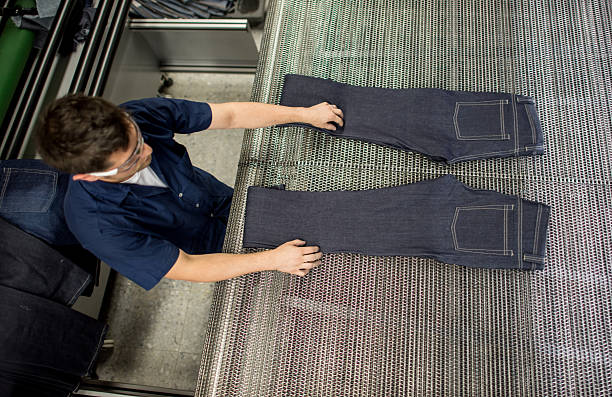
For quality inspection, bulk-production samples should undergo 5 consecutive wash-and-dry cycles.
After testing, the dimensional deviation across key measurements, including:
- Waist
- Inseam
- Thigh
should remain within ±3%.
Therefore, shrinkage testing provides buyers with a more realistic indication of how custom jeans will perform after repeated laundering.
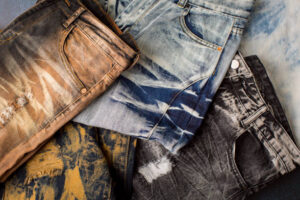
5. Verify Wash Consistency and Colorfastness: Grade 3–4+
Denim washing creates much of the visual character associated with modern jeans. However, processes such as vintage washing, ozone bleaching, and acid treatments must be carefully controlled.
Otherwise, aggressive washing can affect both color consistency and cotton fiber performance.
Color Consistency
Bulk cutting lots should be checked against approved color standards.
For higher-precision production, manufacturers can use spectrophotometer analysis to measure color differences. The specified benchmark is:
Delta E < 1.0
This helps reduce noticeable shade variations between production lots.
Wash Colorfastness
Colorfastness should also be evaluated according to applicable ISO 105 / AATCC standards.
For premium custom denim, the target is Grade 3–4 or higher for dry rubbing/crocking and laundry fastness.
As a result, proper colorfastness testing helps reduce the risk of indigo or other dyes transferring onto skin, shoes, or lighter-colored garments.
Why Quality Control Matters in Custom Denim Jeans Manufacturing
Quality control is not simply a final inspection step. Instead, it should be integrated into every stage of the custom denim jeans manufacturing process.
A reliable QC system connects:
Raw Material → Pattern → Cutting → Sewing → Washing → Finishing → Final Inspection
For example, if fabric weight is incorrect at the beginning of production, later sewing and washing processes cannot fully compensate for the resulting performance difference.
Similarly, excessive elastane, uncontrolled washing, or insufficient seam reinforcement can create defects that only become visible after the garments reach consumers.
Therefore, early-stage testing combined with in-line and final inspections provides a more reliable approach to bulk denim quality management.
Technical Summary
Implementing measurable inspection standards is essential for controlling quality in custom denim jeans manufacturing.
By verifying 10–14 oz fabric weight, 2–5% elastane content, 95% stretch recovery, seam reinforcement, ≤ ±3% dimensional deviation, and Grade 3–4+ colorfastness, apparel buyers can significantly improve bulk-production consistency.
At the same time, testing should not be limited to the finished garment. Instead, buyers should establish quality requirements during material selection, sample development, sewing, washing, and final inspection.
For B2B procurement teams, a combination of PPS approval, AQL inspection, laboratory testing, and production-stage quality control provides a practical framework for reducing sample-to-bulk discrepancies.
YLC provides custom denim manufacturing, OEM denim production, and full-service apparel manufacturing solutions for global fashion brands, wholesale buyers, and private-label apparel companies, supporting customized patterns, fabrics, washes, hardware, branding, sampling, and bulk production.