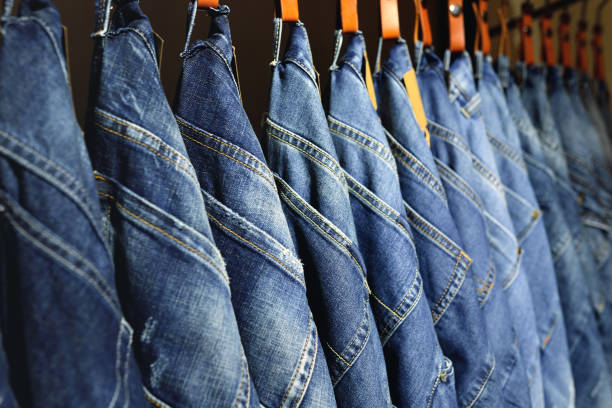
The Commercial Strategic Value of Denim Washing
In the apparel manufacturing industry, the jeans-washing process—commonly known as wet and dry finishing—is the main step that transforms raw, stiff denim into market-ready fashion garments. For global fashion buyers, private label brands, and sourcing managers, understanding denim finishing is not just about aesthetics; it directly impacts unit cost structures, defect rates, and retail profit margins.
A frequent pitfall in denim procurement is positioning mismatch—attempting to sell low-cost basic washes in luxury boutiques, or specifying high-labor handcrafted finishes for budget wholesale markets. Each jeans washing process incurs different chemical, energy, labor, and scrap rate costs. Selecting the right washing technique according to your target demographic is crucial to achieving maximum yield and commercial success.
At YLC, as a specialized custom apparel manufacturer, we provide full-package OEM/ODM garment solutions with precision-controlled denim finishing options. This comprehensive guide breaks down the cost dynamics of popular denim washes, analyzes their technical requirements, and aligns each process with its ideal target market.
1. Technical & Cost Breakdown of Core Denim Washing Processes
1. Normal Wash (Rinse / Desize) – The Budget Baseline
-
Process Dynamics: A basic wet treatment involving water, desizing agents, and mild detergents at $40^\circ\text{C}$ to $60^\circ\text{C}$ to remove starch, soften the fabric, and fix the color.
-
Cost Structure: Lowest operational cost. Minimal chemical usage, low energy consumption, and high drum capacity turnaround.
-
Market Fit: Volume-driven budget markets, basic workwear, mass-market wholesale in Southeast Asia, and promotional retail lines.
2. Stone Wash – The Timeless Casual Standard
-
Process Dynamics: Denim garments are tumbled with volcanic pumice stones in large industrial drums. The mechanical abrasion strips surface indigo dye, creating a faded, contrasting look along seams and pocket edges.
-
Cost Structure: Moderate cost. Requires additional labor for stone unloading, garment flushing, and filter maintenance to clear stone sludge and dust.
-
Market Fit: Mainstream casual collections, high-volume retail brands across North America and Western Europe, and classic everyday basic lines.
3. Enzyme Wash – Eco-Friendly Softness & Fine Texture
-
Process Dynamics: Utilizes organic cellulase enzymes to naturally digest surface cotton fibers, removing fuzz (bio-polishing) and releasing indigo dye without damaging fabric tensile strength.
-
Cost Structure: Slightly higher than stone wash. Requires strict temperature ($45^\circ\text{C} – 55^\circ\text{C}$) and pH monitoring, alongside premium enzymatic formulations.
-
Market Fit: European boutique buyers, contemporary mid-to-high brands in South America, soft-touch ladies’ denim, and eco-conscious apparel lines.
4. Whisker & Hand Scraping (PP Spray) – Artisanal Dimensionality
-
Process Dynamics: A multi-step manual dry-process combined with chemical highlights. Workers use specialized molds or hand sanding to create 3D hip creases (“whiskers”) and thigh abrasions (“monkey wash” / hand scrape), often followed by Potassium Permanganate (PP) localized spraying.
-
Cost Structure: High cost. Heavily dependent on skilled manual labor hours, multi-stage processing, and rigorous safety handling.
-
Market Fit: Premium streetwear, European and American light-luxury brands, fashion-forward denim lines, and designer retail.
5. Heavy Vintage & Distressed Wash – Luxury Craftsman Finish
-
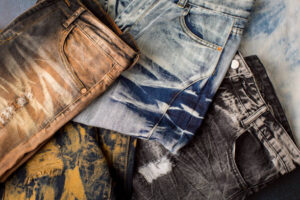
Process Dynamics: Multi-tiered complex processing combining enzyme bio-stoning, manual laser aging, grinding, hand-repair stitching, tinting/overdyeing, and heavy ozone/bleach stripping to achieve authentic vintage aesthetics.
-
Cost Structure: Highest cost. Extended processing times, elevated scrap/scrap-risk rates due to aggressive physical destruction, and intensive multi-pass labor.
-
Market Fit: High-end designer brands, boutique streetwear labels, heritage vintage collectors, and luxury fashion houses.
2. Comparative Matrix: Denim Wash Cost vs. Market Alignment
The table below outlines the cost levels, labor demands, defect risks, and ideal distribution channels across different denim washing categories.
| Washing Process Category | Process Complexity & Labor | Relative Cost Index | Scrap / Defect Risk | Primary Market & Distribution Alignment |
| Normal / Rinse Wash | Minimal (Automated Machine Run) | $ (Lowest) | Near 0% | Mass-Market Wholesale, Southeast Asia, Basic Workwear |
| Stone Wash | Moderate (Machine + Stone Handling) | $$ (Moderate) | Low ($1\% – 2\%$) | Mainstream North American & European Casual Retail |
| Enzyme Wash | Technical (Biochemical Control) | $$$ (Mid-High) | Low ($1\% – 2\%$) | European Boutique Buyers, Mid-Tier South American Brands |
| Whisker & Hand Scrape | High (Multi-Step Skilled Hand Work) | $$$$ (High) | Moderate ($3\% – 5\%$) | US & EU Light-Luxury, Designer Denim, Premium Streetwear |
| Heavy Vintage Distressed | Extreme (Multi-Pass Artisan Finish) | $$$$$ (Highest) | High ($5\% – 8\%+$) | High-End Designer Brands, Niche Luxury Boutiques |
3. Strategic Sourcing Guide: Avoiding Brand Positioning Mismatch
To protect product margins and deliver maximum shelf value, apparel procurement managers should implement a structured wash selection protocol:
-
Calculate Target Retail Margins Backwards: Ensure that high-labor finishes like whiskers or potassium spraying are reserved for price points that absorb multi-pass processing costs.
-
Standardize Wash Master Samples: Establish strict pre-production visual and tactile reference standards (golden samples) to align color shade boundaries, whisker intensity, and fabric hand-feel before mass wet processing.
-
Verify Factory Environmental & Safety Practices: Partner with suppliers that utilize closed-loop water treatment, enzyme bio-processing, or laser/ozone technology to comply with international REACH and OEKO-TEX standards.
4. The YLC Advantage: Precision Apparel Manufacturing & Customization
As a leading global custom apparel manufacturer, YLC combines full-scale garment engineering with technical wash finishing capabilities to support growing apparel brands:
-
Comprehensive OEM/ODM Capabilities: From pattern development and denim weight sourcing (8 oz lightweight to 16 oz heavy selvedge) to custom hardware trim application.
-
State-of-the-Art Wash Infrastructure: Specialized in eco-friendly enzyme wash treatments, precise laser whiskering, localized hand abrasion, and automated ozone color stripping.
-
Rigorous Quality Control: Every production lot undergoes multi-stage inspections—including fabric shrink testing, seam strength verification, and color-fastness audits—to eliminate batch variation.
Conclusion: Optimize Your Denim Product Line with YLC
Mastering the balance between the jeans washing process, production costs, and target market expectations is key to building a profitable apparel line. Selecting the right wash strategy ensures your collection meets consumer quality demands without over-engineering your supply chain costs.
Partner with YLC to bring high-precision denim and custom apparel collections to market. Contact our garment sourcing team today to request fabric swatches, review wash samples, or submit tech packs for competitive factory quotes.